Exploring the Intricate Dance Between Your Circadian Rhythm and Gut Microbiome
Gut Health
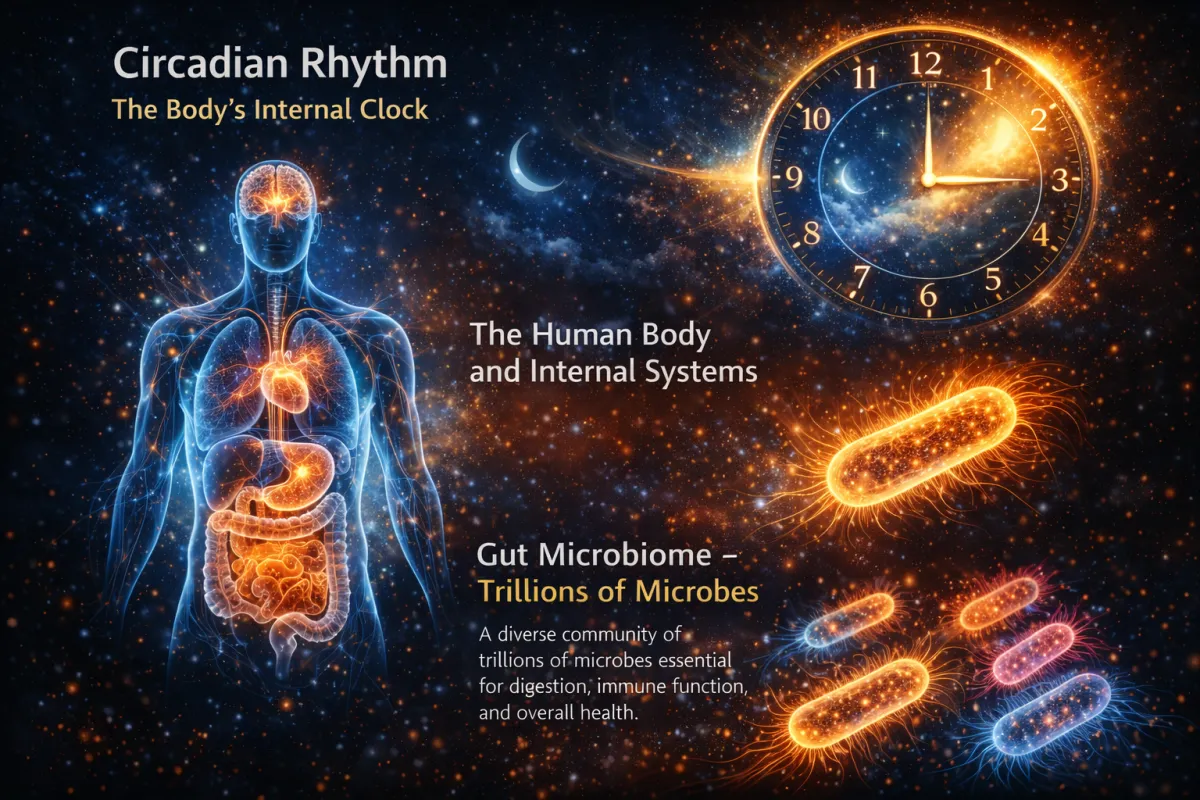
Your body's internal clock, known as the circadian rhythm, orchestrates essential processes from sleep patterns to digestion. Emerging research highlights a fascinating bidirectional interaction with the gut microbiome—the trillions of microbes (also called gut microbiota) in your digestive tract—that profoundly influences overall health, metabolic homeostasis, and even immune function.1
Scientists have established that the circadian rhythm and gut microbiome interact to help the body adapt to daily environmental changes, though the precise molecular mechanisms remain an active area of exploration.
Daily Fluctuations in Gut Bacteria (Microbial Diurnal Oscillations)
The gut microbiome composition isn't static; it exhibits rhythmic daily changes influenced by circadian clock genes that regulate gastrointestinal function.2
Dominant phyla like Bacteroidetes and Firmicutes show rhythmic patterns. In animal studies, Bacteroidetes often peak during fasting (e.g., daytime in nocturnal mice), while Firmicutes rise with feeding.3 These oscillations typically disappear without normal light-dark cycles, underscoring environmental cues' role.4
In humans, similar daily variations in the gut microbiota occur, shaped by meal timing, lifestyle, and feeding-fasting cycles.5
How Circadian Misalignment Disrupts the Gut Microbiome (Leading to Dysbiosis)
Circadian misalignment—from irregular sleep, shift work, jet lag, or social jetlag—alters microbial balance.
Research shows these disruptions reduce beneficial bacteria diversity, favor pro-inflammatory species, and increase gut permeability (leaky gut), contributing to systemic issues.6
For example, sleep restriction and sleep deprivation in humans and animals shift toward pro-inflammatory microbial profiles.7
Compounding Effects: Circadian Disruption Paired with Poor Diet
Circadian misalignment alone stresses the microbiome, but combining it with a high-fat diet or high-sugar diet amplifies damage.
Animal models reveal mild changes on a standard diet, but unhealthy eating plus rhythm disruption causes pronounced dysbiosis (imbalanced gut microbiome), heightened inflammation, and impaired metabolic health.8
Steps to Support Circadian Rhythm and Gut Microbiome Synchronization
Aligning your circadian rhythm with the gut microbiome promotes digestive harmony, microbial rhythmicity, and resilience against the disturbance or alteration of the body's natural biological rhythms.
Practical, evidence-based habits include:
Consistent sleep and wake times to reinforce natural cycles.
Morning sunlight exposure for first 1-15 mins after you wake-up in the morning to anchor your internal clock.
Regular meal timing, ideally within a 10-12 hour window (aligning with time-restricted eating principles).
Stop consuming caffeine at least 6 to 8 hours before bedtime.
Limiting bright light and screens in the evening.
For optimal sleep, wear blue light-blocking glasses 1–2 hours before your planned bedtime to allow natural melatonin production to begin.
A nutrient-dense diet rich in fiber, low in processed foods, sugars, and excess fats to support beneficial microbes and short-chain fatty acids (SCFAs) production.
These routines preserve microbial rhythmicity, enhance metabolic function, and boost daily vitality.9
By tuning into your body's natural rhythms, you cultivate a healthier gut environment and support long-term metabolic homeostasis.
Footnotes
Thaiss CA, et al. Transkingdom control of microbiota diurnal oscillations promotes metabolic homeostasis. Cell. 2014.
Heddes M, et al. The intestinal clock drives the microbiome to maintain gastrointestinal homeostasis. Nat Commun. 2022.
Zarrinpar A, et al. Diet and feeding pattern affect the diurnal dynamics of the gut microbiome. Cell Metab. 2014.
Liang X, FitzGerald GA. Timing the microbes: the circadian rhythm of the gut microbiome. J Biol Rhythms. 2017.
Thaiss CA, et al. Microbiota diurnal rhythmicity programs host transcriptome oscillations. Cell. 2016. (Additional relevant studies on dysbiosis from shift work/jet lag and bidirectional interactions can be added as needed for depth.)
