Rashes, Eczema - Separation Conflicts
The Epidermis and the Separation Conflict: A Germanic Healing Perspective
Based on the work of Dr. Ryke Geerd Hamer
Have you ever noticed that skin rashes, eczema, or hives seem to flare up during emotionally difficult times a breakup, a family conflict, a sudden loss, or for a baby this would be early weaning or separation from mom's bed? Germanic Healing Knowledge (GHK/GNM) offers a compelling answer: these conditions are not mistakes or that there is something wrong with you, and they are not caused by viruses, allergens, or faulty genes. They are the body's biological response to a very specific type of emotional experience known as a separation conflict.
What Is the Epidermis?
The epidermis is the outermost layer of the skin the part you can see and touch. Its primary role is sensory perception: it registers temperature, pressure, and touch, keeping us connected to the world and to the people around us.
Most epidermal cells are keratinocytes, which begin their life in the deepest layer of the epidermis. This is also where hair and nails get their structural foundation keratin.
From an evolutionary standpoint, the epidermis originates from the ectoderm and is controlled from the sensory cortex of the cerebral cortex. Because of a cross-over correlation in the brain, the skin on the right side of the body is managed by the left hemisphere, and vice versa.
The Root Cause: A Separation Conflict
According to GNM, every skin condition involving the epidermis begins with a separation conflict, the biological experience of losing, or being unable to maintain, physical contact with someone or something important.
Dr.Ryke Geerd Hamerdescribed a separation conflict as a true biological state of emergency. In nature, when a young animal is separated from its mother, its chances of survival drop dramatically it may be exposed, vulnerable, and at real risk of death. From a biological perspective, this same ancient program is still active in us. When a baby or young child experiences separation from the mother or primary caregiver, the body does not interpret it as something minor or emotional it perceives it as life-threatening. This is why the reaction can be so deep and intense, and why these moments leave such a strong imprint on both the psyche and the body.
This can take many forms:
A newborn placed in an incubator or given up for adoption experiences separation from the mother's body.
Children suffer separation conflicts when scolded, punished, or separated from a beloved toy, pet, or person.
Adults experience it through the threat of divorce, a difficult long-distance relationship, or the death of a loved one.
Even the elderly can trigger a separation conflict when moved into a nursing home, away from their familiar "pack."
Interestingly, the conflict can also run in reverse the experience of wanting to separate from someone you cannot escape. A terrorizing boss, an abusive spouse, or an annoying colleague can all produce the same biological response as being torn away from someone you love.
Some less obvious triggers include:
Wanting to remove something from your skin (a tight hat, a wet diaper, an oxygen mask)
No longer being able to touch something that mattered deeply (a musical instrument, an engagement ring, a favourite pillow)
A key GNM principle:The psyche cannot always distinguish between a real separation and a perceived or anticipated one. The fear of losing touch with someone even if it hasn't happened yet can be enough to trigger the biological program.
What Happens in the Body
During the Conflict-Active Phase
When a separation conflict is active, the epidermis begins to ulcerate at the specific area of skin associated with the separation. These ulcerations are microscopic and usually go completely unnoticed.
Over time, with sustained conflict activity, the skin in that area becomes:
Dry, rough, and flaky
Pale and cold (due to reduced blood circulation)
Prone to cracking and fissures
In severe cases, the skin may become completely numb a sensory paralysis that is sometimes mistaken for a stroke. The deeper the ulceration reaches into the basal layer of the epidermis, the more serious the changes. When the basal layer which contains the melanocytes responsible for pigmentation is affected, the skin loses its colour, producing the white patches of vitiligo.
On the scalp, this ulceration leads to dandruff and, in deeper cases, hair loss (alopecia).
A fascinating and often overlooked symptom of the conflict-active phase is short-term memory loss. This is the brain's way of helping the organism temporarily "forget" the one who was lost a feature still visible in the animal world, where a mother cat stops recognising her offspring when separated too early. In children, this manifests as learning difficulties and problems concentrating, often labelled today as Attention Deficit Disorder (ADD). In adults, prolonged separation conflicts can contribute to dementia.
During the Healing Phase
Once the conflict is resolved once the separation is no longer felt as a threat the body enters the healing phase. The ulcerated epidermis begins to repair itself through cell proliferation. This is when the skin becomes:
Swollen, red, and inflamed
Itchy and sensitive to touch
Covered in small, fluid-filled blisters
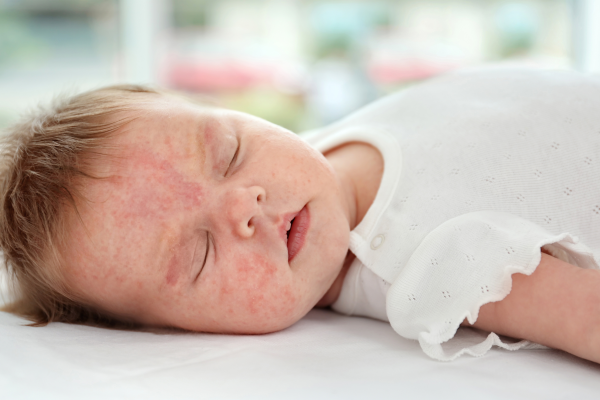
This healing process is what medicine labels as a skin rash. In GNM terms, conditions such as dermatitis, eczema, hives, measles, rubella, chickenpox, rosacea, lupus, psoriasis, and herpes are not distinct diseases with separate causes they are all expressions of the same biological healing process, differing only in location, depth, and intensity.
Note on corticosteroids: Topical cortisone creams are commonly prescribed for inflammatory skin conditions. While they suppress the visible rash, they also interrupt the healing phase. This is why, in most cases, the rash returns shortly after the cream is discontinued.
Where the Rash Appears and What It Means
One of the most striking aspects of GNM is that the location of a skin rash is not a mistake. It maps directly to the area of skin involved in the original separation.
Type of separation Where the rash appears Wanting to hold or embrace someone Inside of arms, hands, fingers, or legsWanting to push someone away Outside of arms, elbows, legs, knees, shinbones, or ankles Head or scalp-related separation Scalp or head Kissing-related conflict. Lips or face (cold sores) Wanting or not wanting to leave a place Chest, belly, toes, or feet Generalized separation conflict Widespread body rash (exanthema)
Whether the right or left side of the body is affected depends on the person's handedness and whether the conflict involves a partner, a child, or a parent.
Common Skin Conditions Through a GNM Lens
Vitiligo and Albinism
When the separation conflict is experienced as particularly brutal involving physical abuse, the sudden loss of a loved one, or deep humiliation the ulceration reaches deep into the basal layer, destroying the pigment-producing cells. The result is vitiligo: white patches of depigmented skin at the precise location associated with the separation. Hair growing on affected areas also turns white.
Albinism represents the extreme case a generalized brutal separation conflict experienced in utero, resulting in a complete and permanent loss of skin pigmentation.
During the healing phase of vitiligo, if conflict relapses occur repeatedly, the skin can become hyper-pigmented, producing light brown patches known as café-au-lait spots.
Psoriasis
Psoriasis is a unique case in GNM because it involves two simultaneous separation conflicts one in the conflict-active phase and one in the healing phase, both overlapping in the same area of skin. This produces the characteristic appearance: silvery scales on a thick, red surface.
The location tells the story. Psoriasis on the elbows, for example, might reflect a conflict of wanting to push someone away ("elbow room") occurring at the same time in two different relationships at work and at home.
What is called psoriatic arthritis in conventional medicine is, in GNM terms, a combination of separation conflicts and self-devaluation conflicts occurring simultaneously.
Herpes and Cold Sores
Herpes blisters develop at the exact area of skin that was involved in the separation conflict. Blisters on the lips (cold sores) are linked to a conflict around kissing wanting to be kissed and not being able to, not wanting to be kissed, oral sex-related distress, or even the act of giving up smoking ("cigarette withdrawal").
The sun can act as a recurring conflict track, explaining why some people reliably get cold sores after sun exposure.
Genital herpes is linked to a sexual separation conflict: the loss of a sexual partner, sexual rejection, unwanted sex, or sexual abuse.
Eczema, Contact Dermatitis, and "Allergies"
When a skin rash keeps coming back in response to a specific trigger, a food, a piece of jewellery, a pet. Germanic Healing Knowledge explains this through the concept of conflict tracks. The object was present at the moment the original separation conflict occurred, and the psyche has since associated it with that emotional experience. Each re-encounter reactivates the conflict and restarts the healing process.
This is what conventional medicine calls a contact allergy. The object is not the cause it is merely the track that leads back to the original conflict.
Babies who develop dermatitis around the mouth and cheeks when breastfeeding is stopped abruptly are experiencing the separation from the mother's body. If the first taste of formula milk coincides with this conflict, a milk allergy can be established.
Hives (Urticaria)
Hives are the healing phase of a separation conflict. The specific location of the rash reveals the nature of the conflict. A widespread outbreak on the back, for example, might be connected to a "get off my back" track someone who feels burdened, crowded, or invaded by another person.
Erysipelas
Characterised by a painful, sharply bordered rash that looks like severe cellulitis, erysipelas is the healing phase of a localised separation conflict. The affected area whether the right leg, the left arm, or the face corresponds to where the body registered the separation.
Childhood Diseases
Measles, rubella, and chickenpox all share a common theme: a widespread skin rash covering most of the body. In GNM terms, this reflects a generalized separation conflict, typically experienced by infants and young children who are especially vulnerable to separation from their caregivers and peers.
These conditions are not "contagious infections" in the conventional sense. They are collective healing events multiple children experiencing the same type of separation conflict at the same time, such as in a kindergarten class where children have become attached to a teacher and suddenly feel separated from her.
Scarlet fever involves a separation conflict at two layers of the epidermis simultaneously the underside (producing white patches, similar to vitiligo) and the upper surface (producing the rash). The characteristic "raspberry tongue" points to an additional conflict involving the mouth.
Warts, Genital Warts, and Scleroderma
Warts develop when a separation conflict relapses repeatedly without full resolution. Each relapse restarts the healing process, and the excessive cell proliferation from accumulated healing creates a raised or flat growth. Genital warts (condyloma) are linked to persistent sexual separation conflicts.
Plantar warts (on the soles of the feet) reflect a conflict of not wanting to stand where one is wanting to leave a place but being unable to or, conversely, not wanting to leave.
Scleroderma a hardening of the skin results from a prolonged healing phase that never quite completes. Over time, the repeated proliferation and repair of epidermal tissue causes the skin to thicken and harden. This is the body's healing mechanism running on a loop, unable to finish because the underlying conflict keeps reactivating.
The Takeaway
At the root of so many separation conflicts is a deeper misunderstanding of our biological design how conflicts are experienced in the psyche, mapped in the brain, and expressed through specific organs, as well as how men and women naturally relate through polarity. This is exactly what I bring together in my signature course, Living in Biological Harmony, where you can begin to understand these patterns at their source and finally see how it all connects.
From the GHK perspective, the epidermis is not just a passive covering it is a living, responsive layer of tissue that records our emotional history and communicates it back to us through its condition. Every rash, every patch of dry skin, every blister has meaning.
Rather than suppressing symptoms, GHK encourages understanding the root cause of the conflict: Who or what were you separated from? When did it happen? What in your current life might be reactivating that original experience?
With that awareness, many people find that the skin remarkably begins to heal on its own.
Source: Living in Biological Harmony ·
Original research by Dr. Ryke Geerd Hamer ·
DISCLAIMER: The information in this article is for educational purposes only and does not replace professional medical advice.